Grateful for progress, asking for more
Calling for sensible safety improvements and keeping all options on the table for A1 safety.
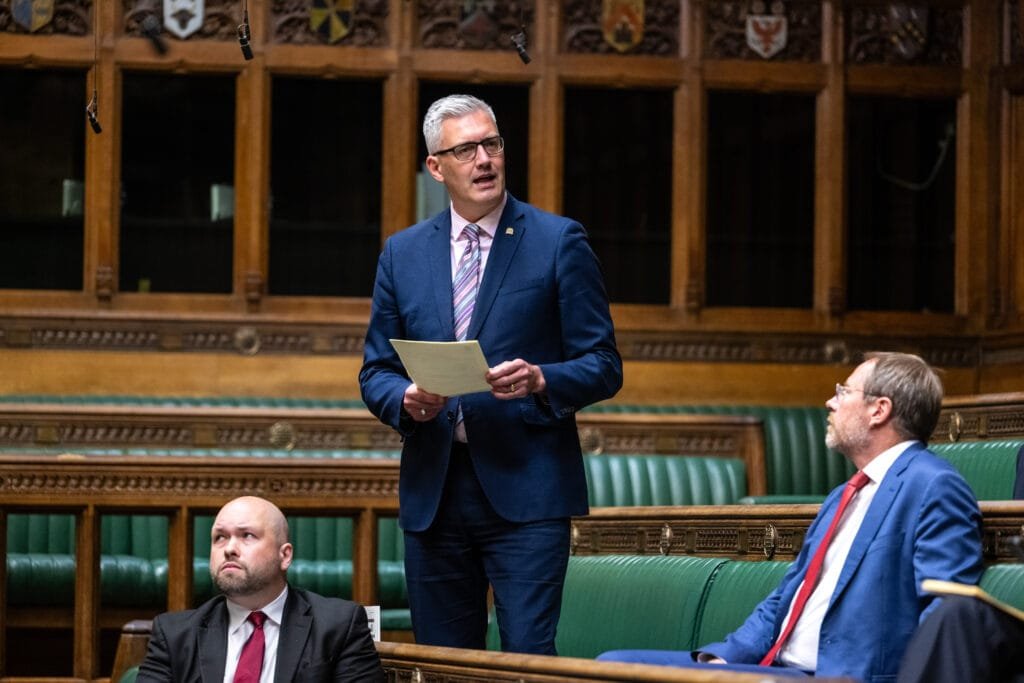
My speech in full, from Wednesday’s adjournment debate on A1 safety
According to the Newcastle Chronicle, on 31st May Emma Bartlett Scott said to her husband that they shouldn’t use the A1 as part of their journey that day: ‘I had a bad feeling that day’, she said, ‘we [had] had the [recent] fatalities and I said to my husband that I didn’t know if we should go on the road.’
Her worry was proven right.
As the Scotts neared the end of their journey and waited to turn off the A1 – stationary, in the middle of the road – they were rear-ended and pushed into the other lane. If the drivers coming the other way hadn’t been alert, they would have been hit again, head-on, at 60 mph.
Thankfully the couple are ok, but the dreaded necessity of using the A1 is felt deeply throughout North Northumberland.
Mr Speaker I would today like to outline the condition of the road; welcome the support of the Government and National Highways for planned improvements on the road as part of Road Investment Strategy 3; and advocate for greater investment for the A1 in the years ahead.
North Northumberland A1 fears
This road is The issue for my constituents – it is a critical part of their lives, but presently one they would rather do without. The A1 holds North Northumberland back and is littered with overlapping problems. It is not a safe road. But it has also become a totem for the frustrations of my northern constituents.
They feel – rightly – that investment is always going somewhere else, often to places in the South, like Manchester or Leeds, instead of to them in the true North.
With the new rules in the Green Book, and with a devolution agenda coming to Westminster, I hope that the Government will increase its attention on this road in the years to come.
Current A1 Situation
The A1 from Morpeth to Berwick in my constituency stretches for nearly 50 miles, switching between a few dualled parts and single carriageway – which is the majority of the road. It is part of National Highways’ strategic road network, and is the road from London to Edinburgh – it is the east coast equivalent of the M6 – as well as the central feature of my constituency of North Northumberland.
In my constituency thousands use it as part of their daily lives, including me and my team. And almost all of the ten million tourists who visit Northumberland every year, many of them from abroad, will use the road as part of their travels too.
Tragically, six people have died on the A1 since the beginning of May, with more injured; 11 people have died on the road this year alone. My prayers are with them and their loved ones.
Police data, which hasn’t yet been updated with the most recent incidents, suggests that since 2014 there have been 768 accidents along the A1 through Northumberland, from Seaton Burn to Berwick. 176 of these were serious and 24, sadly, were fatal.
And while less serious accidents are falling rapidly, serious and fatal accidents remain persistent.
No-one should lose their life on our roads.
There are several problems with the A1. The first problem is the vast number of minor at-grade turnings – my office counted at least 140 of these turnings from Morpeth to Berwick.
At these junctions, stationary local traffic must merge with highway traffic along the same gradient, often on to a single lane. There are rarely slip roads to help build up speed.
Cars wanting to cross to the other side must wait for gaps in traffic and time their crossings expertly. Some of these crossings are so narrow that long vehicles and vans extend into the road, obstructing traffic going past them at 60mph.
These -crossing places are among the worst elements of the A1 and are loathed by everyone who has to use them. Data from 2025 suggests that intersections are responsible for 43% of crashes from Alnwick to Berwick and 30% of crashes on the southern section of the route.
Guyzance, Charlton, Hebron, Chevington, Fenwick, Belford, Denwick
Guyzance, Charlton, Hebron, Chevington, Fenwick, Belford, Denwick – all Northumberland villages, but all better known for their high-risk junctions and intersections. The second problem is overtaking and unsafe driving.
In 2021 the Planning Inspectorate found that ‘The A1 suffers more overtaking accidents than would be expected on a road of this type’. Stretches like Mousen Bends and the merging of lanes at dual and single sections are notorious.
My point was made for me when National Highways visited the road with me last year. We had barely entered the single-lane section when we were overtaken by a car driving above the speed limit and into traffic.
There is no improvement that could fix this reckless behaviour.
It was also tragic to learn that two of the recent fatality incidents involved foreign nationals. As North Northumberland becomes more popular in summer, tourists who lack local A1 know-how are risking their own lives – and the lives of local residents – without knowing it.
The third problem is mixed traffic use. As well as cars, the A1 – as an unusually mix of local and national road – plays host to both HGVs and tractors. On the single lane sections this has the effect of slowing down traffic and generating driver frustration, leading to the reckless overtaking mentioned a moment ago.
Congested A1
Linked to this is the fourth problem: congestion.
Average seconds per vehicle mile, a measure of traffic speed and congestion, are much higher than the national average north of Alnwick; and are double the national average around Berwick and the Scottish border, with some sections registering over 25 seconds per vehicle mile in 2024.
Congestion on the A1 is so high because it lacks resilience and capacity. The single lane stretches and frequency of collisions means that even a minor incident has major consequences.
Traffic is delayed and redirected through tiny rural villages, with the effect of gumming the entire region up. All of these problems contribute to each other.
Risky junctions and crossing points, dangerous – or unfamiliar – driving, mixed vehicle types, and slow travel times. All of these create a road that lacks safety, resilience and capacity. There is no silver bullet for these problems.
Dualling would certainly fix some of them.
Conservative government fails on A1
In 2014, the Conservative government promised they would dual the A1 from Morpeth to Ellingham.
Between 2014 and 2024 Conservative Governments left the EU, burned through five Prime Ministers, and saw the Scottish football team reach a major tournament for the first time since 1998.
But the one thing they couldn’t do is lay 13 miles of new road in North Northumberland.
The costs ballooned to half a billion pounds; the funding for the project was quietly withdrawn in 2021 – before being briefly resurrected, surprisingly just before the 2024 general election; and no-one at any point seemed to have figured out an answer to the most basic question: ‘where will the money come from?’
And that is despite the previous MP for the area being – albeit briefly – the Transport Secretary responsible for the road.
So while it is certainly true that dualling would do a lot of good for the road, it is also true that that particular dualling project was long dangled and never delivered.
Recent Improvements
It is clear to me that what we need most urgently are sensible safety improvements that tangibly improve the quality of the road from Morpeth to Berwick. That includes improvements at key junctions, but also signage, markings, speed cameras and the like.
Because of the long promised dualling project, there have been no substantial improvements to the road since 2014.
But over the past two years my office has been working with National Highways to deliver two route treatment studies of the full 50-mile route – so that we know exactly where the problems are and what the road needs;
And we have secured funding as part of the massive, national Road Investment Strategy 3, so that the A1 can have the necessary improvements that make journeys safer; I am very grateful to the Minister and to his predecessor for the time and attention they have given to me and to the A1 so far.
And I also want to share my appreciation for the National Highways team at Yorkshire and North-East, who continue to work hard on improving this road.
Planning is still continuing, but I am looking forward to driving along the A1 and seeing new improvements for the first time in over 10 years.
The Case for Greater Investment
But as I hope I have demonstrated, the problems along the A1 are varied and overlapping – and to be absolutely fair, 50 years in the making. Fixing these problems will require years of attention.
But might this be the Government that will fix this road once and for all?
That is why, ahead of Road Investment Strategy 4 – or RIS4 – in the coming years, I want to make the case for everything to be on the table for the A1.
That includes ongoing uplifts for the road’s condition; major improvements at problem junctions; and, yes, dualling for the entire length of road.
The Treasury Green Book reforms have made clear that ‘value for money’ is about more than cost, and more than purely financial ROI.
And the new Green Book sits squarely behind the ambitions of place-based growth and long-term transformation rather than short-term economic yield.
This means that regions like the North-East can be prioritised based on how their growth can be unlocked – which means recognising where weak infrastructure is limiting the potential for new housing developments, tourism growth or business confidence.
The focus on ‘transformational change’ – where a project might take decades to be fully realized – is a quietly revolutionary shift that changes the way we think about improving the A1.
All of these changes must be acknowledged as we enter the RIS4 cycle.
So I want to ask the Minister what consideration he and his Department will be giving to the road as part of RIS4 and in light of the Green Book changes?
I fully support a full menu of improvements to the road; and I believe that there is a sustainable case to be made for them.
There is also a political case. When the £11bn Lower Thames Crossing gets the nod ahead of the A1; and when the London-Birmingham HS2 will cost as much as the GDP of Belarus; my constituents might be inclined to suspect that – just occasionally – there is a North-South divide.
I’m thinking of Northern Powerhouse Rail, the Transpennine Route Upgrade – all of these are welcome projects, but what about infrastructure in the true North of England?
If we are serious about devolution and unlocking regional economies – and I believe that we are – then the A1 is the place to start.
Conclusion
In conclusion, M Speaker, the A1 dominates the lives of my constituents in North Northumberland.
It is unsafe, lacking in resilience, and not fit for the future of a region that is booming in tourism and has so much to offer.
This hangs over every journey my constituents make.
It is a mess of overlapping problems that chokes the region’s potential.
That’s why I am so pleased that we have secured the first substantial improvements in over ten years following Labour’s investment earlier this year.
Instead of a long-dangled but never-delivered dualling for the south of the constituency, we will have necessary improvements from Morpeth to Berwick.
And I want to go further. My expectation is simple: a safer A1 – including dualling.
All options should be on the table.
If we are serious about devolution, I urge the Minister and the Government to apply the reformed Green Book and deliver maximum improvements on the A1.
The Scotts, thankfully, survived their collision.
Others, and there will be more to come, have not.
It is our job to ensure we do all we can to minimize the risks of this road. We have no time to waste.
‘If we are serious about devolution, I urge the Minister and the Government to apply the reformed Green Book and deliver maximum improvements on the A1.’
-David Smith
MP for North Northumberland